1. Introduction
This chapter introduces the project's foundational elements, beginning with the team’s composition and motivation. It defines the core problem, the proposed solution, and the primary objectives. Finally, it outlines the technical requirements and the testing procedures used to verify their fulfillment.
1.1 Presentation
The 'Divers' team comprises six students from various nations with diverse academic backgrounds. Brought together at ISEP to participate in the EPS, the team objective is to leverage the collective skills to develop a sustainable solution for a real-world challenge. Figure 1 shows the group that represents Maris Habitats.
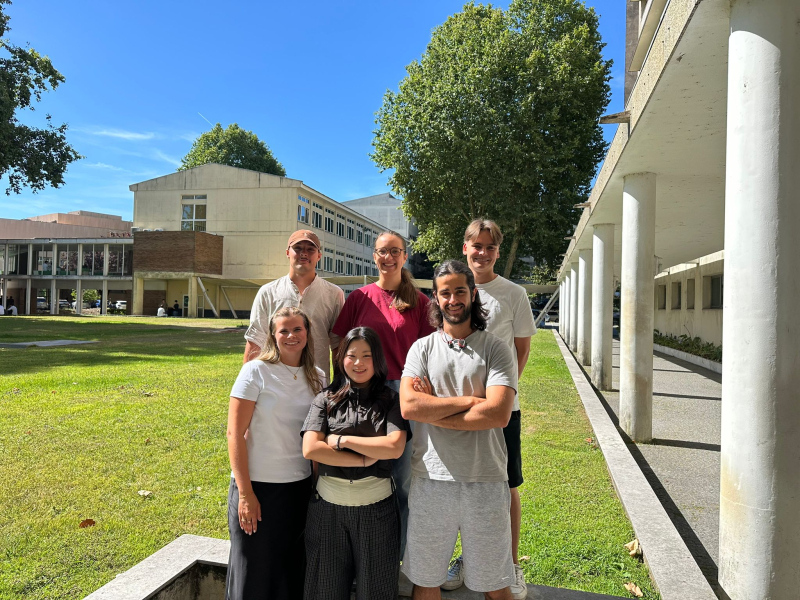
| Name | Country | Field of Study |
| Hernán Nieto Marabini | Spain | Biomedical Engineering |
| Chaehee Kim | South Korea | Industrial Engineering |
| Ida Schmitt | Germany | Interactive Media |
| Isak Björk | Finland | Electrical Engineering & Automation |
| Louis Van Nederkassel | Belgium | Product Development |
| Oda Kristine Johansen Fossvoll | Norway | Information Technology |
1.2 Motivation
The motivation for this project is based on the growing concern about the degradation of marine ecosystems and the decline of natural reef habitats. Coral reefs and other complex seabed structures provide important habitats for many marine species, including fish, invertebrates, and algae. However, many of these ecosystems are currently under pressure due to factors such as climate change, pollution, overfishing, and habitat destruction.
Artificial reefs have been proposed as one possible approach to support marine biodiversity and help restore degraded habitats. By creating structures that mimic the complexity of natural reef environments, artificial reefs may provide shelter, feeding areas, and breeding grounds for marine organisms. Understanding how different materials and structural designs influence these habitats is therefore an important topic in marine environmental research.
1.3 Product
Maris Habitats is a modular reef infrastructure and environmental monitoring system designed for underwater environments. The product combines physical Reef Blocks with an optional removable Smart Module, allowing it to provide both habitat support and long-term environmental data collection.
The Reef Blocks are concrete habitat structures designed to be placed on the seabed. They include surfaces, cavities, and sheltered spaces that may support habitat formation over time. Instead of claiming immediate biological recovery, the product focuses on providing a physical structure that can be used in marine restoration, research, or environmental monitoring projects.
The Smart Module is the removable monitoring assembly of the system. It consists of the Smartlogger and the Smartlogger attachment. The Smartlogger is the rectangular box that contains the sensors, battery, SD card, and electronic components used for environmental monitoring. The Smartlogger attachment supports and holds the Smartlogger on the Reef Block.
The Smartlogger collects environmental data from selected locations around the reef structure. This data can help users understand local site conditions and observe how the reef and surrounding marine environment change over time. The monitoring system is designed to operate with low power consumption and store data locally, reducing the need for continuous communication infrastructure.
The final product is intended for organizations such as public institutions, coastal municipalities, research groups, environmental non-governmental organizations (NGOs), port authorities, aquaculture operators, and marine infrastructure companies. These customers may use Maris Habitats as part of restoration projects, long-term monitoring programs, sustainability reporting, or environmental decision-making.
1.4 Problem
The basis for this idea is the global environmental challenge of marine ecosystem degradation. The causes of this problem are multiple; global warming are raising ocean levels and ocean temperatures. This is altering the conditions of most of the underwater ecosystems, and this evolves in multiple species having to migrate from their original environments to new ones.
Another major issue is the impact of human fishing activities on marine ecosystems. Fishing is practiced worldwide and is regulated by governments and various institutions. However, in some areas, intensive fishing can disturb marine food chains and contribute to the decline of certain fish populations. These changes may also affect other species that depend on balanced marine ecosystems.
The third environmental concern is the decline of marine oxygen production and overall ecosystem balance. Changes in marine fauna can also affect marine flora, including algae and coral reef ecosystems. Coral reefs, such as the Great Barrier Reef, are under pressure from climate change, rising sea temperatures, and other environmental stressors. Their degradation can affect biodiversity, habitat quality, and the stability of marine ecosystems. Therefore, there is a growing need for solutions that support marine restoration and long-term ecosystem monitoring.
1.5 Objectives
This project focuses on developing a sustainable and technically feasible concept for a modular artificial reef system with environmental monitoring functions. The main goal is not to prove immediate biological recovery, but to design a reef structure and a basic sensing system that can support future marine restoration and monitoring projects.
The first objective is to design a modular reef structure that can be adapted to different sites and project sizes. The structure should be made of repeatable Reef Blocks that can be combined in several ways. These blocks should provide surfaces, cavities, and sheltered spaces that may support habitat formation over time.
Another important objective is to select materials that are suitable for marine conditions. For the final design, durable and environmentally compatible materials, such as basalt fiber-reinforced concrete, are considered because they can improve resistance to seawater conditions and reduce long-term environmental risks [1], [2].
The project also aims to include a removable Smart Module. Instead of placing electronics permanently inside the Reef Block, the system uses a Smartlogger placed in a Smartlogger attachment. The Smart Module consists of the Smartlogger and the Smartlogger attachment. This makes it easier to check, repair, or replace electronic components without removing the whole Reef Block from the seabed.
A further objective is to collect useful environmental data. In the final system, the intended parameters include temperature, pressure or depth, pH, and conductivity. This data can help users understand the conditions around the installation site and observe how the surrounding marine environment changes over time.
For the prototype, the objective is more limited. The prototype is intended to validate the basic sensing and data logging concept under controlled conditions. Due to budget and component availability, it uses a simplified sensor set, including temperature, pressure, and total dissolved solids (TDS). The pH and conductivity sensors are reserved for the final product.
Finally, the project aims to reduce unnecessary disturbance to the marine environment. The removable Smart Module allows maintenance, battery replacement, and data collection to be carried out without disturbing the main Reef Block. Since the Smartlogger can be removed from the Smartlogger attachment, failed or damaged electronic components can also be taken out instead of being left underwater.
1.6 Requirements
This section defines the main requirements of the Maris Habitats system. The requirements are divided into functional and non-functional categories. Functional requirements describe what the system should do, while non-functional requirements define the conditions needed for safe and reliable operation in a marine environment.
Because the project separates the final product from the prototype, the requirements are also considered at two levels. The final product is intended for long-term marine deployment, while the prototype is designed to validate the basic sensing and data logging concept under controlled conditions.
1.6.1 Functional Requirements
The physical reef structure must include cavities, textured surfaces, and sheltered spaces that may support the attachment and growth of marine organisms over time [3].
The structure must be modular, so that several Reef Blocks can be combined and adapted to different project sizes and site conditions.
The final system must collect environmental data at predefined time intervals. The intended final measurement parameters include water temperature, pressure/depth, pH, and conductivity.
The prototype uses a simplified sensor set due to budget and component availability. For prototype testing, the measured parameters include temperature, pressure, and TDS. The pH and conductivity sensors are reserved for the final product.
The collected data must be stored locally using a data storage unit such as a Secure Digital (SD) card. This allows long-term operation without relying on external communication infrastructure or real-time underwater data transmission.
Energy consumption must be minimized to extend the operational lifetime of the monitoring system. This is achieved through low-power operation, where the system remains active only during short measurement cycles.
The system must perform measurements periodically, typically once per hour. During each cycle, the system remains active only for the time required to stabilize sensor readings and store the data.
The Smartlogger must be removable from the Smartlogger attachment so that battery replacement, sensor inspection, maintenance, and data retrieval can be carried out without removing the whole Reef Block from the seabed.
1.6.2 Non-Functional Requirements
In addition to functional capabilities, the system must satisfy several non-functional requirements to ensure safe and reliable operation in marine environments. Since the structure is deployed underwater and interacts directly with marine ecosystems, material selection, structural stability, waterproofing, and maintenance access are critical.
To avoid environmental risks, the Reef Block structure must be made from durable, non-toxic, and environmentally compatible materials that do not release harmful substances into the marine environment. Poorly selected artificial reef materials can create long-term environmental problems, as shown by previous failed reef projects such as Osborne Reef [4].
For the final product, basalt fiber-reinforced concrete is considered as the main structural material because basalt fibers are known for corrosion resistance and chemical stability in marine environments [5].
The Reef Block must be designed to remain stable under expected currents and wave conditions without displacement. Artificial reef guidelines emphasize that reef materials should be stable and remain at the intended deployment site [6].
All electronic components, including sensors, batteries, and storage units, must be enclosed in a waterproof Smartlogger housing with at least IP68 protection to prevent water ingress and support underwater operation [7].
The Smartlogger must be designed to reduce the risk of leakage, corrosion, and internal moisture. Moisture-absorbing materials may be used inside the enclosure to help control condensation.
The Smartlogger design must allow access for maintenance, battery replacement, and data retrieval. This is especially important because the system stores data locally and requires scheduled retrieval.
The prototype does not need to meet the same marine-grade requirements as the final product. It is intended for controlled testing and should be clearly presented as a simplified validation model rather than a final deployable system.
1.7 Tests
The main objective of testing the prototype is to verify that the Maris Habitats concept functions as intended under controlled conditions. Since the prototype is a simplified validation model, the testing phase focuses on three main aspects: the basic operation of the sensor system, the structural stability of the Reef Block, and the protection of the electronic components. The final product is intended for long-term marine deployment, whereas the prototype is primarily used to validate the measurement and data-logging concept in a controlled environment. For this reason, the prototype tests will focus on temperature, pressure, and Total Dissolved Solids (TDS) measurements, while more advanced parameters such as pH and conductivity are reserved for the final product.
A structural test will be carried out using SOLIDWORKS simulation tools. This test will be used to analyze how the Reef Block structure responds to applied forces and to evaluate whether the design can withstand expected mechanical loads. The simulation will help identify possible weak points in the structure and support further design improvements before physical production or deployment.
A prototype test will be performed in air to verify the basic functionality of the Smartlogger electronic system. This test will confirm whether the sensors, microcontroller, power supply, and data storage system operate correctly before any water-related testing is considered. The purpose of this stage is to reduce technical risk by ensuring that the system can collect and store sensor data under safe and controlled conditions.
These tests will provide an initial validation of the prototype and help determine whether the system is ready for further development and more realistic environmental testing.
1.8 Report Structure
| Chapter | Description |
|---|---|
| 1. Introduction | Introduction to the project and the report |
| 2. Background and related work | Previous similar projects with common useful knowledge |
| 3. Project management | Distribution and important aspects about the project itself |
| 4. Marketing plan | Analysis of the market and economic feasibility |
| 5. Eco-efficiency Measures for Sustainability | Sustainable responsibilities in different aspects |
| 6. Ethical and Deontological Concerns | Different ethical points of view for the project |
| 7. Project development | Evolution from the design to the prototype |
| 8. Conclusions | Final ideas of the outcomes achieved and next steps |
| 9. Bibliography | Information sources |