4. Marketing Plan
4.1 Introduction
The marketing plan for MARIS HABITATS focuses on positioning the project as a modular reef infrastructure and environmental data solution within the blue economy. Rather than claiming immediate biological recovery, the project focuses on what it can directly provide: scalable reef blocks, removable monitoring units, and long-term environmental data.
The reef blocks create a physical structure in the marine environment and can provide surfaces, cavities, and sheltered spaces that may support habitat formation over time. The removable smart sensor box collects environmental data from selected locations, helping customers understand site conditions and environmental changes around the reef.
This positioning is relevant for public institutions, coastal municipalities, research organizations, environmental NGOs, port authorities, aquaculture operators, and marine infrastructure companies. These customers may need reef infrastructure, environmental monitoring, or data-based support for restoration evaluation, sustainability reporting, research, or decision-making.
This chapter defines the market context, target customers, positioning, and marketing-mix strategy for MARIS HABITATS.
4.2 Business Idea Formulation
The business idea of MARIS HABITATS is based on the need for marine habitat restoration and long-term environmental monitoring. Coastal and offshore areas are increasingly affected by habitat degradation, pollution, overfishing, and climate-related pressures. At the same time, the blue economy is becoming more important, as it aims to use ocean resources for economic growth while preserving the health of marine ecosystems [1].
Artificial reefs have already been used for habitat restoration, fishery enhancement, research, and coastal management. However, their effectiveness depends on suitable design, site selection, materials, and long-term monitoring [2], [3]. This creates an opportunity for a solution that does not only provide a physical reef structure, but also supports environmental data collection.
MARIS HABITATS responds to this need by offering a modular reef block system with an optional smart sensor box. The reef blocks provide scalable underwater infrastructure, while the smart box collects environmental data from selected locations. The purpose of the data is to help customers understand site conditions and observe how the reef and surrounding marine environment change over time.
The paying customers are not individual consumers, but organizations that benefit from better monitored marine environments. These may include public agencies, coastal municipalities, environmental NGOs, research institutions, port authorities, aquaculture operators, and marine infrastructure companies. For these customers, MARIS Habitats can provide reef infrastructure and data-based support for restoration evaluation, sustainability reporting, research, and decision-making.
The business model can be developed in stages. First, small pilot projects can be used to test the structure, sensor system, and data collection method. Second, customers can purchase reef modules and optional smart boxes depending on the scale and purpose of the project. Third, annual monitoring services can be offered, including battery replacement, sensor inspection, data collection, and environmental reports.
This approach allows MARIS Habitats to move beyond a one-time product sale. The project can be positioned as a scalable marine restoration and monitoring service, where customers can start with a small installation and expand the system over time.
4.3 Business Model Canvas
In this section, the Business Model Canvas for MARIS HABITATS is presented. Figure 1 provides an overview of the main elements of the business model, including customer segments, value proposition, channels, customer relationships, revenue streams, key resources, key activities, key partners, and cost structure. Each section of the canvas is explained in more detail below.

1. Customer Segment The product is being created for the fish and the sea-life, they are a very niche market where few people are helping. It is very diversified but the team will try to narrow it down. Concerning who is the product being sold to, it is intended to be bought by governments and non profit organizations, who are the ones gaining the secondary advantage of the impact. A third part is involved, not the fish as the main beneficiary, or the society because the improvement in general of the seas, but also the science, since the team will be working with researching institutions to manage the data that will be collected data.
2. Value Proposition An improvement in life quality and marine environments is proposed to provide shelter and increase reproduction rates for sea life. For research institutions, the objective is the provision of high-quality data applicable to various research purposes. This project is of interest to governments as it facilitates the restoration of marine life, which aids in water quality for human use, improves the quality and market price of fish, and enhances the general quality of society.
3. Channels The primary focus is placed on reaching buyers through direct personal contact, while social awareness and transparency are established through a dedicated website and social media presence.
4. Customer Relationships Zero contact will be maintained with underwater life to ensure no disturbance occurs. Regarding research centers, real-time data is provided via automated services, while reports and management data are requested to be shared to foster cooperation across multiple locations. For governments, the focus is on developing long-term environmental partnerships that allow for a solid investment foundation.
5. Revenue Streams Funding is secured through various government programs for sustainable development and from non-profit organizations dedicated to marine restoration. Additionally, private funding is sought from philanthropists and private NGOs to support the project’s goals.
6. Key Resources The main resource is the workspace, consisting of a facility with an initial area for research and computer-based tasks, and a second area fully dedicated to building models, ranging from material modeling to sensor implementation and testing. If mass production of the structures is required, a factory will be necessary to produce them sequentially and at a high rate of speed.
7. Key Activities The scope of activities includes the design and construction of habitats, as well as the installation of sensors. This is followed by the deployment of the habitats on the seabed and their subsequent initialization. The management of the resulting data is delegated to research centers and institutions.
8. Key Partners Governments are expected to act not only as clients but also as partners in determining site locations and establishing fishing regulations in those areas. The relationship with research institutions is mutually beneficial, as they are provided with data to analyze while offering feedback for the project. Furthermore, partnerships are sought with marine businesses, ship owners, and diving enterprises, to assist with transportation and sea deployment.
9. Cost Structure
The total budget is divided among the model construction (material and manufacturing costs), the sensors and necessary electronic materials, and the expenses associated with deployment, including ships, delivery, and divers. Additionally, worker salaries are included in the event of a transition to mass production.
4.4 Market Analysis
Marine ecosystem degradation is increasingly recognized as both an environmental and economic challenge. Coastal and offshore areas are affected by pressures such as climate change, pollution, overfishing, and habitat loss. These pressures can reduce habitat quality and create a need for restoration, monitoring, and better environmental decision-making [4], [5].
Artificial reefs have already been used in different parts of the world as tools for habitat support, fishery enhancement, research, and coastal management. However, their effectiveness depends on suitable site selection, structural design, material choice, and long-term observation [6], [7]. Many existing reef solutions mainly function as physical structures and do not include environmental data collection as a core feature.
At the same time, public institutions, research organizations, environmental NGOs, port authorities, aquaculture operators, and marine infrastructure companies increasingly need measurable environmental information. This data can support restoration evaluation, sustainability reporting, research, and long-term site management.
This creates a market opportunity for a solution that combines modular reef infrastructure with practical environmental monitoring. MARIS HABITATS responds to this gap by offering reef blocks that can be installed alone or combined with optional removable smart sensor boxes. The sensor boxes collect data at scheduled intervals and store it locally for later retrieval, instead of relying on real-time underwater communication.
The primary target market consists of institutional and organizational customers rather than individual consumers. These include national and regional authorities, coastal municipalities, research institutions, environmental NGOs, port authorities, aquaculture operators, and companies involved in marine or coastal infrastructure.
The most realistic market entry strategy is gradual validation. Small pilot projects can first be used to test the reef structure, sensor box, maintenance process, and data retrieval method. After technical validation, the system could be expanded through public funding, research partnerships, environmental programmes, or project-based services.
In this context, MARIS HABITATS is positioned as a modular reef infrastructure and environmental data solution. Its market value comes from combining scalable reef blocks with optional monitoring services, allowing customers to start with a small installation and expand according to their budget, monitoring needs, and project goals.
4.4.1 PESTEL ANALYSIS
A PESTEL analysis is a tool used by many businesses to study the general environment in order to decide a business strategy. This general environment is divided into several segments from the industry and competitor environment. This analysis is conducted to identify changes in society to allow for the adaptation and integration of the business within it.
4.4.1.1 Political
Politically, the current situation is highly advantageous. The European Union (EU) has identified the same problem and has addressed it through the publication of The Nature Restoration Law (NRL), which mandates that member states take corrective action. Consequently, in the face of a sudden surge in demand, the market supply position is excellent, making the participation of government agencies in the project even more likely.
4.4.1.2 Legal
Following the framework of section 4.4.2.1, the United Nations (UN) has published The High Seas Treaty (BBNJ). This international law reaches more than 60 nations and provides a legal framework for establishing Marine Protected Areas (MPAs) in international waters, emphasizing area-based management tools and environmental impact assessments in the deep seas. These operations align with the business proposal and provide a structured framework to be followed.
4.4.1.3 Economic
Economically, 2026 has marked a leap from research to large-scale implementation, and the funds and budgets allocated to these efforts have grown accordingly. In line with the previously mentioned regulations, substantial amounts have been made available by various organizations:
- The EU, through the LIFE Program, is financing approximately 60 – 70 % of projects with grants ranging between € 1 M and € 5 M for those within the “Nature and Biodiversity” calls. Furthermore, under the specific mission “Restore our Ocean and Waters,” calls have been launched with a budget exceeding € 115 M for nature-based solutions and habitat mapping.
- The UN, following the BBNJ Treaty, has activated the Global Environment Facility (GEF) with a total fund of € 5.3 B, which supports environmental challenges through projects similar to this one. From this special fund, 50 % is being allocated to finance large protected areas in international waters.
- Lastly, at the national level, both Spain and Portugal (both potential target locations) have initiatives such as the PLEAMAR and Empleaverde+ programs, or the NextGen funds (Spain), as well as the Blue Fund (Fundo Azul) and the 2026 State Budget (Portugal). All of these collectively aim toward fishing sustainability, marine restoration, and ecosystem recovery.
4.4.1.4 Social
On a social level, several arguments gain momentum year after year. The restoration and creation of habitats have their primary impact on the creation of “shelter zones.” This allows for an increase in biomass, which socially stabilizes the economy of fishing areas and reduces conflicts arising from resource scarcity. Furthermore, these habitats indirectly boost diving tourism by diverting tourist pressure from overexploited natural reefs toward controlled, managed areas, promoting a sustainable blue economy.
In addition, the improvement of marine habitats enhances water quality and protects beaches from erosion. This increases the overall quality of life in coastal cities, particularly in high-tourism regions such as the target countries, Spain and Portugal.
4.4.1.5 Technological
Technologically, the project is currently at its least robust point. There is an ongoing boom where all activities must be monitored, recorded, and measured to demonstrate efficacy and numerically evaluate utility. Funding bodies, in particular, demand project reliability. Dependence is placed on a simple system that allows for these requirements to be met without overcomplicating the process.
Other projects involve 3D scanning of the implementation or restoration area for simulations, or high-resolution mapping using sonar. However, the project goals do not include these types of systems; due to the technological gap, a simpler monitoring system is preferred to provide the necessary security without resorting to excessive, highly invasive, and ultimately unnecessary testing.
4.4.1.6 Environmental
The implementation of marine habitats is subject to strict oversight by regulatory bodies under the EU Nature Restoration Law (NRL), which require studies proving that the intervention will not negatively alter pre-existing dynamics. To this end, baseline characterization studies are conducted for subsequent comparison after implementation.
Another study of great importance is ecological connectivity to assess interaction with the environment; this serves as the Gold Standard for creating ecological corridors that facilitate species migration and climate change adaptation. Finally, other impact assessment and ecosystem service studies support the project to ensure its success.
Despite these well-defined tests and studies, this area may prove challenging due to numerous regulatory requirements and limited professional experience in the field. Consequently, efforts will be intensified to satisfy both technical and social requirements.
4.4.2 SWOT Analysis
The main strengths, weaknesses, opportunities, and threats of MARIS HABITATS are summarized in Figure 2.
4.4.2.1 Strengths
One of the main strengths of MARIS HABITATS is the combination of modular reef blocks and a removable smart sensor box. The system is not only designed as a physical reef structure, but also as a tool for collecting environmental data around the reef over time.
Another strength is its modularity. Customers can start with a small number of reef blocks and later expand the system depending on the project size, budget, and monitoring needs. Since the smart sensor box is removable, maintenance, battery replacement, and data retrieval can be carried out without removing the whole reef structure from the seabed.
The system also has value for long-term environmental observation. Instead of relying on real-time underwater communication, the smart box stores data locally and allows the data to be retrieved during scheduled maintenance. This reduces technical complexity and power consumption while still supporting later analysis.
4.4.2.2 Weaknesses
A main weakness of MARIS HABITATS is the technical complexity of combining reef structures with sensors, batteries, waterproof housing, and data storage. Even though the system avoids real-time underwater transmission, the electronic components still need to operate reliably in harsh marine conditions.
Another weakness is the cost of marine-grade components. Pressure-resistant housings, underwater connectors, and durable sensors can be expensive, especially for the final product. The prototype uses lower-cost alternatives, but these are only suitable for controlled testing and cannot fully represent long-term marine deployment.
Maintenance is also a limitation. The system is designed for long-term local data logging, but the smart sensor box still needs to be retrieved periodically for battery replacement, sensor inspection, and data collection. This may require divers or technical partners, which can increase operational costs.
4.4.2.3 Opportunities
MARIS HABITATS can benefit from the growing demand for marine restoration, environmental monitoring, and data-based decision-making. Public institutions, coastal municipalities, research organizations, NGOs, port authorities, aquaculture operators, and offshore infrastructure companies may need solutions that combine reef infrastructure with environmental data collection.
There is also an opportunity to develop pilot projects with local authorities, universities, or marine infrastructure partners. These pilot projects could help test the modular reef blocks, the removable smart sensor box, and the annual data retrieval process before larger-scale deployment.
Another opportunity is the development of a service-based model. In addition to selling reef modules, MARIS HABITATS could offer annual monitoring services, including battery replacement, sensor inspection, data collection, and environmental reports. Basic datasets could also support research and education, while project-specific analysis could be offered as a paid service.
4.4.2.4 Threats
Several threats are related to the marine environment itself. Strong currents, storms, pressure, corrosion, and biofouling can affect the long-term performance of both the reef structure and the smart sensor box. These factors may increase maintenance needs or reduce data quality.
Regulatory approval can also be a threat. Since the system is installed underwater and interacts with marine environments, deployment may require permits, environmental assessment, and cooperation with local authorities. This can delay implementation.
Market adoption may also be slow because MARIS HABITATS is a hybrid system. It is not only an artificial reef and not only a monitoring device, so customers may need time to understand its value. Existing companies in marine infrastructure and reef restoration may also create competition, especially if they already have stronger market recognition or established partnerships.

4.5 Strategy
4.5.1 Strategic Objectives
To determine the team's objectives, a SMART framework was set, ensuring the goals are Specific, Measurable, Achievable, Relevant, and Time-bound. A 3 to 5-year horizon was defined to minimize ambiguity and ensure strategic alignment.
- Short-to-Medium Term: The primary objective is to demonstrate the system's feasibility through a functional prototype and establish strategic partnerships with research institutions, NGOs, and local authorities for pilot deployment.
- Long Term: Beyond the initial scope, the project aims to scale the solution into a modular and sustainable artificial reef system dedicated to marine ecosystem restoration and data-driven coastal management.
Monitoring, Metrics, and Baselines The implementation of specific and measurable Key Performance Indicators (KPIs) will serve as the project’s compass. A longitudinal monitoring approach will be utilized, comparing post-deployment data against a rigorous environmental baseline (the “Year 0” measurements). This comparative analysis is the only scientifically valid method to quantify biodiversity net gain, water quality improvement, and structural integrity over time.
Critical Relevance in a Global Context The urgency of these objectives cannot be overstated. As detailed previously, marine ecosystems are approaching a critical tipping point. The degradation of these habitats threatens keystone species responsible for essential ecosystem services, including global oxygen production—driven by phytoplankton and healthy reef systems—and the sustenance of human populations that rely on the sea for food security. This strategy is not merely a business goal; it is a response to a global ecological imperative.
Achievability and the “Experimental” Paradigm In alignment with the World Wide Fund for Nature (WWFs) classification, this project is categorized under the Experimental Frontier. Unlike mature projects with predictable outcomes, this project operates in a dynamic environment where it is necessary to push technical boundaries. Recognizing this “experimental” nature allows us to maintain operational flexibility. Marine variables—such as current shifts, temperature fluctuations, and pH levels—require an adaptive management style, allowing us to pivot team's tactics without compromising the core strategic objectives.
4.5.2 Segmentation and Targeting
Unlike traditional consumer products, this solution is not based on standard demographic or psychographic segmentation. Instead, it focuses on geographical and environmental conditions, especially coastal areas with similar marine characteristics.
At this stage, the main focus is on the Atlantic coast of Portugal and Northern Spain. These regions have similar ocean conditions and biodiversity, which makes it easier to apply the system without major design changes.
Although the European Union is the main institutional partner and initial market, the long-term goal is to expand to other regions with similar marine environments. Potential areas include the northeastern United States, southwestern Canada, western New Zealand, and central Chile.
In future developments, the system could also be adapted to different climates, including tropical and colder regions, allowing for wider global application.
From this perspective, the targeting strategy focuses on the main stakeholders within these regions. After identifying where the system can be implemented, it is important to define who benefits from it.
The project aims to improve marine biodiversity, support fish population growth, and contribute to better water quality. In addition, it can help reduce coastal erosion and protect coastal infrastructure by absorbing wave energy.
Unlike traditional solutions, the system also includes an integrated monitoring component that provides continuous environmental data. This supports data-driven decision-making for coastal management and long-term planning.
For these reasons, the main target audience includes national governments, regional authorities, and coastal municipalities. These stakeholders are responsible for environmental management and have the capacity to invest in long-term infrastructure.
The partnership strategy is based on three main criteria:
- Environmental awareness: recognition of marine ecosystem degradation
- Financial capacity: ability to support long-term investment
- Strategic alignment: consistency with sustainability policies
In this context, the EU Biodiversity Strategy for 2030 provides a strong framework, as it aligns with the objectives of this project and supports funding opportunities.
4.5.3 Positioning
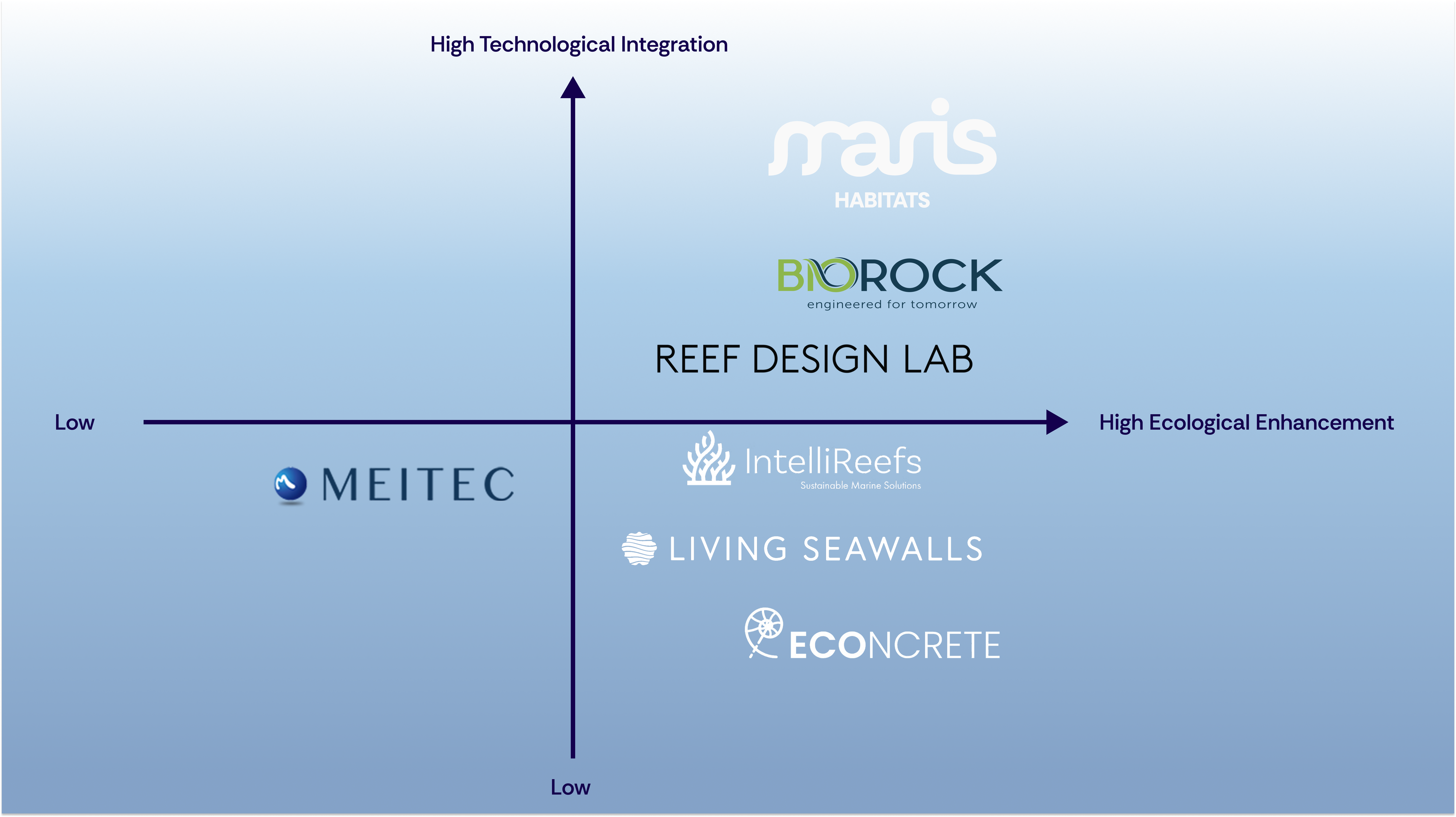
The positioning of MARIS HABITATS and selected existing companies is shown in Figure 3. The map is based on two main criteria: ecological reef design on the horizontal axis and environmental data capability on the vertical axis. These criteria were selected because MARIS HABITATS is not only intended as a physical reef structure, but also as a system for collecting environmental data around the reef over time.
ECOncrete, Reef Design Lab, IntelliReefs, and rrreefs are positioned on the right side of the map because they strongly focus on ecological reef design, habitat creation, or reef restoration. ECOncrete focuses on bio-enhancing concrete infrastructure, while Reef Design Lab and rrreefs use modular and 3D-printed reef structures. IntelliReefs focuses on Oceanite-based artificial reef structures for marine restoration.
However, these companies are positioned lower in terms of environmental data capability because their publicly available product descriptions do not clearly show a removable sensor box or long-term local data logging as a core product feature. Their main value is related to ecological design, material innovation, or reef restoration, rather than direct environmental data collection.
MARIS HABITATS is positioned in the upper-right area of the map. This is because the project combines modular reef blocks with a removable smart sensor box. The system is not designed for real-time underwater data transmission. Instead, it stores environmental data locally and retrieves it during scheduled maintenance, approximately once per year.
Overall, the positioning map shows that many existing companies focus strongly on reef design or ecological enhancement, while fewer solutions combine reef infrastructure with long-term environmental data collection. This highlights a potential market gap that MARIS HABITATS aims to address through its modular reef structure and removable monitoring unit.
4.5.4 Marketing-Mix
Product
MARIS HABITATS is a modular marine infrastructure and environmental monitoring system. The product consists of reef blocks, an optional removable smart sensor box, and a data-based monitoring service. The reef blocks provide cavities, rough surfaces, and sheltered spaces that may support habitat formation over time. The smart sensor box collects environmental data such as temperature, pressure/depth, and water quality indicators from selected locations around the reef.
The collected data is not intended to prove immediate ecological recovery. Instead, it helps users observe how the reef structure and surrounding marine conditions change over time. This makes MARIS HABITATS useful for marine restoration support, research, environmental monitoring, and long-term site observation.
A key part of the product strategy is modularity. Customers can first install the reef blocks alone and later add smart sensor boxes if monitoring is needed. This gives public institutions and companies more flexibility, because they do not need to invest in the full system from the beginning.
The smart sensor box is not included in every reef block. For larger installations, only selected modules may include monitoring units in order to collect representative environmental data while reducing total system cost. The removable design also allows battery replacement, sensor inspection, maintenance, and data retrieval without removing the whole reef structure from the seabed.
The final product could include different service levels. A basic version would include the reef blocks only. A standard version would include reef blocks and selected smart sensor boxes. A premium version could include yearly maintenance, data collection, sensor inspection, battery replacement, and environmental reports. In this way, MARIS HABITATS becomes more than a physical product; it becomes a modular platform for reef infrastructure, environmental monitoring, and data-based decision-making.
Price
The pricing strategy for MARIS HABITATS follows a modular and scalable model. Since the system is made of separate reef blocks and optional smart sensor boxes, the total price depends on the number of reef modules, the number of monitoring units, the selected sensor package, and the level of service required by the customer.
The reef structure can be priced per block. This allows customers to start with a small pilot installation and expand the system later by adding more modules. For larger restoration or monitoring areas, more reef blocks would be required, while smaller projects could begin with only a limited number of units. This makes the product more flexible for public institutions, research organizations, and companies with different budgets.
The smart sensor box would be offered as an optional add-on rather than being included in every reef block. For example, if a project installs 50 reef blocks, it may only need 5 smart boxes placed in selected locations. These boxes can collect representative environmental data from the site while reducing the total cost of the system. This is important because large installations do not need sensors in every single module.
Different sensor packages could also be offered. A basic package could include temperature and pressure/depth sensors. A standard package could include additional water quality indicators such as conductivity. More advanced options, such as pH or other specialized sensors, could be offered for projects with higher budgets or more specific research needs.
In addition to the physical product, MARIS HABITATS could offer an annual monitoring service. This service could include data retrieval, battery replacement, sensor cleaning, sensor inspection, and an environmental report. Through this model, customers would not only pay for the reef structure itself, but also for long-term monitoring and data-based insights. This creates a more stable business model and turns MARIS HABITATS into a scalable marine restoration support and monitoring service.
Place
Because MARIS HABITATS is not a consumer product, it would not be distributed through normal retail channels. The product is intended for institutional and project-based customers, such as public authorities, coastal municipalities, port authorities, research institutions, environmental NGOs, aquaculture operators, and marine infrastructure companies.
The distribution strategy should therefore be based on direct sales, partnerships, and pilot projects. Instead of selling the product through shops, the team would approach potential customers directly and offer project-specific solutions depending on the site, budget, monitoring needs, and environmental goals.
At the first stage, the main geographical focus would be the Atlantic coast of Portugal and Northern Spain. These regions are suitable as an initial market because they are close to the project location and have comparable marine conditions. Starting in nearby regions also makes communication, testing, transport, installation, and maintenance easier.
After validation through pilot projects, MARIS HABITATS could be expanded to other coastal regions with similar marine environments. Possible future markets include other European coastal areas and international regions where artificial reef structures or environmental monitoring systems are needed. However, expansion to different climates or ecosystems would require additional testing and local adaptation.
The installation and maintenance process would likely require cooperation with local partners. These may include diving teams, marine contractors, port operators, research institutions, or environmental agencies. This partnership-based distribution model is important because underwater installation, annual data retrieval, and sensor maintenance require site access and technical support.
Promotion
The promotion strategy should focus on clear, realistic, and evidence-based communication. Since MARIS HABITATS is presented as an environmental solution, promotion must avoid exaggerated claims or greenwashing. The system should not be promoted as a complete solution that can fully restore marine ecosystems by itself. Instead, communication should explain what the system can realistically provide: modular reef infrastructure, optional environmental monitoring, and long-term local data collection.
The main promotional message should emphasize the difference between MARIS HABITATS and existing artificial reef solutions. Many existing systems focus mainly on reef structure or ecological design. MARIS HABITATS adds value by combining modular reef blocks with a removable smart sensor box that stores environmental data locally for later analysis.
Promotion should be targeted at professional and institutional audiences rather than the general consumer market. Suitable channels include direct presentations to public authorities, research institutions, port authorities, environmental NGOs, and marine infrastructure companies. The team could also use project reports, technical brochures, academic presentations, environmental innovation events, and professional networking platforms.
Digital communication can also support promotion. A website or project page can explain the system, show the modular structure, describe the sensor box, and present pilot project results when available. Social media can be used for awareness, but the content should remain informative and technical rather than overly promotional.
For early-stage promotion, pilot projects are especially important. Demonstrating the system in a controlled or small-scale marine environment would help build credibility. Data collected from pilot deployments could later be used in reports, presentations, and case studies to show how the system works and what kind of environmental information it can provide.
Overall, the promotion strategy should present MARIS HABITATS as a realistic and modular solution for marine infrastructure and environmental monitoring. The focus should be on transparency, technical feasibility, long-term observation, and collaboration with institutions that are already involved in marine restoration, research, or coastal management.
4.5.5 Brand
The name of the product is Maris Habitats. Maris is of Latin origin, meaning “of the sea”. This name was chosen to reflect the mission: to give back to the ocean and support the growth of new marine habitats.
Logo
The Maris logo (see Figure 4) is inspired by the movement of the ocean: fluid and continuous. It captures the essence of water through a single, uninterrupted line, symbolizing flow, connection, and natural rhythm.

Color System
The Maris color palette (see Figure 5) is inspired by the depth and diversity of the ocean. It balances cool aquatic tones with a vibrant accent, reflecting both calmness and life beneath the surface.
- Deep Sea Blue — #14004D Foundation color Represents depth, mystery, and stability
- Ocean Blue — #004AAD Core brand color Clear, strong, and evoking open water
- Fish Blue — #5C9FD5 Secondary tone Adds lightness and movement
- Sky Blue — #DDEBF6 Background color Soft, breathable, and minimal
- Coral Orange — #EE4C01 Accent color Inspired by coral reefs, used for highlights, energy, and contrast
- Orca White — #F9F9F9 Neutral base Clean, modern, and versatile

Graphic Elements
The graphic language (see Figure 6) of Maris is derived from marine ecosystems, translating organic underwater forms into bold, modern visuals. The organic shapes are inspired by coral, sea plants, and flowing water. Shapes are soft, rounded, and natural. The elements overlap to create depth, mimicking underwater environments and ecosystems.

4.6 Marketing Programmes
4.6.1 Programmes
4.6.2 Budget
4.6.3 Control
Summary
Provide here the conclusions of this chapter and make the bridge to the next chapter.
Based on this market/economic analysis, the team decided to create <specify the type of product> intended for <specify the market niche> because <specify here the relevant market-related reasons>. Consequently, the team decided to design a solution with the following <specify here the features added for market reasons>.