2. Background and Related Work
2.1 Introduction
This chapter establishes the technical and scientific foundation for the MARIS HABITATS project by situating it within the broader context of artificial reef design and underwater environmental monitoring. Traditional artificial reefs are usually passive structures that provide physical habitat support, while marine monitoring systems are often treated as separate technical equipment.
MARIS HABITATS aims to connect these two areas by combining modular reef infrastructure with a removable smart sensor box. Instead of focusing on real-time data transmission, the system is designed for long-term local data logging. This approach reduces technical complexity and makes the concept more realistic for a low-power underwater system.
The chapter reviews artificial reef concepts, existing companies, material options, sensor placement challenges, and biological and geographical factors. This background helps justify the project direction: a modular reef block system supported by environmental data collection rather than a fully live underwater IoT platform.
2.2 Concepts
Artificial marine habitats can be designed in several ways to help restore marine ecosystems and support endangered fish species. One approach is the use of 3D-printed reef corals, which can be made from materials such as ceramic, limestone, or eco-concrete. These materials are durable and suitable for marine environments. Examples of projects using this approach include Reef Design Lab in Australia, which develops 3D-printed reef structures for marine habitat restoration, and SECORE coral restoration projects, which focus on rebuilding damaged coral reefs by supporting coral growth and reef recovery [1], [2].
Another commonly used solution is reef balls. These are concrete dome structures with holes that mimic natural reef caves. Because of their simple design they are easy to mass produce and very stable when placed on the seabed. The holes and cavities provide immediate shelter for fish and other marine animals, allowing the structures to quickly function as protective habitats [3], [4].
A different method is the creation of Bio-Rock or electric reefs. These reefs consist of metal structures through which a small electrical current is passed. This current causes minerals from seawater to deposit onto the structure, gradually forming a limestone-like coating. This process helps corals grow much faster than under normal conditions, and fish rapidly colonize these artificial reefs. This technique is known as Bio-Rock technology [5].
Artificial habitats can also be designed as modular “fish cities”. These structures include holes of different sizes so that multiple fish species can use them for shelter. Vertical elements are often incorporated to mimic natural reef cliffs, and the modules can be interconnected to create more complex ecosystems that support a greater diversity of marine life [6].
Another concept is the development of living seawalls. These are harbor walls or seawalls designed with textured panels and cavities so that marine organisms can attach to them and live on them. Instead of smooth concrete surfaces that support little life, these modified structures create habitats for algae, small invertebrates, and fish [7].
Several endangered fish species can benefit from these types of artificial habitats, including the Humphead wrasse, Nassau grouper, Atlantic Goliath Grouper, Smalltooth Sawfish, and the European eel. Although many of these species grow quite large, the habitats are especially important for juvenile fish. Young fish can use the structures as shelter and breeding areas, increasing their chances of survival. When more juvenile fish survive, adult populations can recover and thrive. Larger predators may also benefit by hunting around these habitats.
In habitat design, the shape of the structure is often more important than the material used. It is important to include many holes and cavities in different sizes so that different fish species can find suitable shelter. Vertical structures are also important because they mimic natural reef cliffs. In addition, rough surface textures help corals and algae attach and grow on the structures. Finally, ensuring good water flow around the habitat is essential, as it brings nutrients and oxygen that support marine life.
2.3 Comparative Analysis
The selected companies and solutions are evaluated based on criteria such as reef structure, modularity, material approach, monitoring capability, data collection method, maintenance, and suitability for long-term environmental observation.
Since MARIS HABITATS is designed to observe how an artificial reef and the surrounding marine conditions change over time, the comparison looks beyond ecological enhancement. It also considers whether each solution can collect, store, and retrieve environmental data for later analysis.
| Criteria | ECOncrete | Reef Design Lab | IntelliReefs | rrreefs | MARIS HABITATS |
|---|---|---|---|---|---|
| Main business focus | Bio-enhancing concrete for marine and coastal infrastructure | Designed and 3D-printed reef structures | Oceanite-based artificial reef restoration | 3D-printed modular clay reef restoration | Modular reef infrastructure and environmental data |
| Product type | Eco-engineered concrete infrastructure units | Modular reef modules and design services | Artificial reef modules made with Oceanite marine substrate | Interlocking 3D-printed clay reef modules | Reef blocks with a removable smart sensor box |
| Main application | Ports, seawalls, shoreline protection, offshore assets, and subsea cable protection | Reef restoration and marine habitat construction | Coral reef restoration and marine habitat support | Coral reef regeneration and habitat creation | Reef installation, environmental monitoring, and long-term site observation |
| Modularity | Moderate | High | High | High | High |
| Ecological design focus | High | High | High | High | Moderate to high |
| Material / design approach | Bio-enhancing concrete composition, surface texture, and macro-design | Ceramic 3D-printed modular reef structures | Oceanite bio-enhancing marine substrate | 3D-printed clay modules inspired by natural reef structures | Basalt fiber-reinforced concrete blocks and removable sensor housing |
| Integrated sensors | No clear indication as a core product feature | No clear indication | No clear indication | No clear indication | Yes |
| Real-time data transmission | No clear indication | Not specified | Not specified | Not specified | No |
| Long-term local data logging | No clear indication as a core product feature | Not specified | Not specified | Not specified | Yes |
| Data retrieval method | Not specified | Not specified | Not specified | Not specified | SD card / scheduled annual retrieval |
| Service model | Project-based marine infrastructure solution | Design and project-based reef solution | Restoration project-based solution | Impact-driven reef restoration projects with local partners | Reef modules with optional monitoring and data service |
| Main differentiation | Ecological concrete material and infrastructure integration | Complex modular reef design | Alternative Oceanite-based reef material | 3D-printed clay reef modules and local restoration partnerships | Removable sensor box and long-term environmental data |
The comparison presented in Table 1 is based on publicly available information from company websites, project descriptions, and related documentation. The selected companies represent different approaches to artificial reef and marine infrastructure development. ECOncrete focuses on bio-enhancing concrete for marine and coastal infrastructure, while Reef Design Lab focuses on designed and 3D-printed modular reef structures. IntelliReefs uses Oceanite-based artificial reef structures for reef restoration, and rrreefs develops 3D-printed clay modules for coral reef regeneration.
Compared with these companies, MARIS HABITATS is positioned as a modular reef infrastructure and environmental data solution. The project does not focus only on ecological design or reef structure, but also on collecting environmental data around the reef over time. The main difference is the removable smart sensor box, which stores data locally and allows scheduled retrieval during annual maintenance.
2.4 Companies
This section reviews selected companies related to artificial reef systems and marine habitat infrastructure. The aim is to understand how existing companies approach reef structure, material choice, modularity, and ecological design.
The review also considers whether these solutions include monitoring or environmental data collection as a core feature. This helps identify the position of MARIS HABITATS as a modular reef infrastructure system with a removable smart sensor box and long-term local data logging.
ECOncrete
ECOncrete is a company that develops bio-enhancing concrete technologies for coastal, marine, and offshore infrastructure. Its solutions are designed to improve the ecological performance of concrete structures while still maintaining their engineering function. The company’s approach is applied in infrastructure such as ports, seawalls, coastal protection systems, offshore assets, and subsea cable protection.
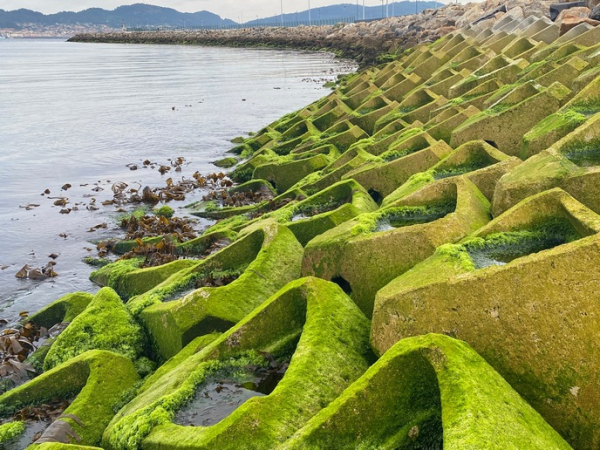
The main idea of ECOncrete is to make marine infrastructure less biologically poor than conventional smooth concrete structures. This is achieved through changes in concrete composition, surface texture, and structural design. According to the Living Ports project, ECOncrete’s rough and irregular surfaces, gaps, and swim-through holes can create habitats, shelter, and breeding spaces for marine organisms [8].
One example of ECOncrete’s application is the Living Ports Project at the Port of Vigo. In this project, ECOncrete Coastalocks and ecologically enhanced seawalls were used to create nature-inclusive port infrastructure. As shown in Figure 1, marine growth can develop on these concrete elements over time, showing how infrastructure can maintain its coastal protection function while also supporting ecological value.
However, ECOncrete is different from MARIS HABITATS in its main focus. Based on the available product descriptions, ECOncrete mainly provides bio-enhancing concrete infrastructure rather than a modular reef system with a removable sensor box. There is also no clear indication that long-term local data logging is included as a core product feature. Therefore, ECOncrete is a useful benchmark for ecological concrete design, while MARIS HABITATS aims to add environmental data collection through a removable smart monitoring unit.
Reef Design Lab
Reef Design Lab is an Australian design and fabrication company that develops artificial reef and marine habitat solutions. The company describes its work as the design, prototyping, and manufacturing of coastal solutions, with a focus on improving ecological performance in artificial reefs and coastal habitat infrastructure [10].
One of its well-known systems is MARS, which stands for Modular Artificial Reef Structure. MARS is a ceramic 3D-printed modular system designed to construct reef habitat without the need for heavy-duty equipment. The system can be deployed from small boats and assembled by divers, making it suitable for reef restoration projects in locations where large marine construction equipment may be difficult to use [11].
Reef Design Lab is relevant to MARIS HABITATS because both projects use modular reef structures and focus on creating physical habitat infrastructure in underwater environments. The use of repeated modular units also makes Reef Design Lab a useful benchmark for comparing scalability, deployment, and structural complexity.
However, Reef Design Lab differs from MARIS HABITATS in its main focus. Based on the available product descriptions, Reef Design Lab mainly focuses on reef design, 3D-printed structures, and project-based marine habitat solutions. There is no clear indication that a removable sensor box or long-term local environmental data logging is included as a core product feature. Therefore, Reef Design Lab is useful as a benchmark for modular reef design, while MARIS HABITATS aims to combine modular reef blocks with a removable smart monitoring unit for long-term environmental observation.

IntelliReefs
IntelliReefs is a reef restoration initiative and technology platform connected to Reef Life Foundation. It focuses on engineered artificial reef structures made from Oceanite, a bio-enhancing marine substrate designed to mimic natural ocean mineral compounds. According to IntelliReefs, Oceanite can be customized according to site, species, and function, and is used to create reef modules that support coral, seaweed, kelp, and other marine organisms [13].
The main idea of IntelliReefs is to combine material science with reef design. Its Oceanite material is described as a complex mineral matrix held together by a proprietary nanobinder, developed to support diverse species growth and integration into local ecosystems [14]. The structures are designed with textured and porous surfaces, as well as small spaces where marine organisms can attach, be protected, and grow over time.
As shown in Figure 3, IntelliReefs uses modular reef units that can be arranged to create complex underwater habitats. These structures are relevant to MARIS HABITATS because both concepts use modular reef elements and aim to create underwater infrastructure that can interact with the surrounding marine environment.
However, IntelliReefs differs from MARIS HABITATS in its main focus. Based on the available information, IntelliReefs mainly focuses on Oceanite-based artificial reef structures and marine restoration solutions. There is no clear indication that a removable smart sensor box or long-term local environmental data logging is included as a core product feature. Therefore, IntelliReefs is a useful benchmark for alternative reef materials and ecological reef design, while MARIS HABITATS aims to combine modular reef blocks with removable sensor-based monitoring for long-term environmental observation.
rrreefs
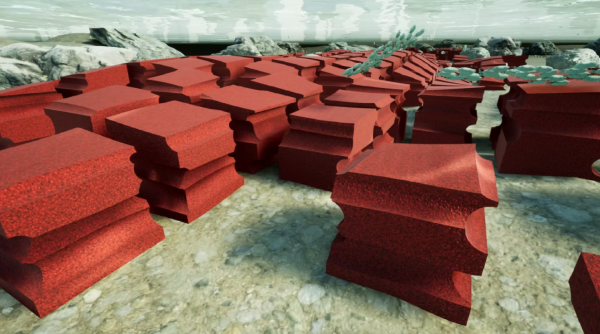
rrreefs is a Swiss start-up that focuses on rebuilding and regenerating degraded coral reefs. The company develops a 3D-printed modular reef system made from clay, designed to support coral growth and provide habitat for marine life [16].
The rrreefs system is based on interlocking clay modules that can be arranged in different shapes depending on the local reef conditions and restoration needs. These modules are designed to mimic natural reef structures, create habitat diversity, and provide sheltered spaces for coral larvae, juvenile fish, crustaceans, and other marine organisms. As shown in Figure 4, the modular units can form complex underwater structures.
rrreefs is relevant to MARIS HABITATS because both concepts use modular reef structures and aim to create underwater infrastructure that can interact with the surrounding marine environment. The company is also relevant as a business benchmark because it operates as an impact-driven reef restoration start-up and works with local partners to implement reef projects in different countries.
However, rrreefs differs from MARIS HABITATS in its main focus. rrreefs mainly focuses on coral reef regeneration through 3D-printed clay reef modules and local restoration partnerships. Based on the available product descriptions, there is no clear indication that a removable smart sensor box or long-term local environmental data logging is included as a core product feature. Therefore, rrreefs is a useful benchmark for modular reef design and reef restoration business models, while MARIS HABITATS aims to combine modular reef blocks with removable sensor-based monitoring for long-term environmental observation.

2.5 Materials
For this project involving a marine habitat at a maximum depth of 50 m off the Portuguese coast, the materials must withstand a pressure of approximately 5 bar while fostering biological growth and protecting sensitive sensors. To ensure the highest level of efficiency and environmental compatibility, various materials used in international restoration efforts has been analyzed.
The selection of materials and the structural design of artificial habitats are fundamental to ensuring both environmental compatibility and long-term viability. For this project, concrete has been identified as the primary material due to its exceptional durability and its proven track record in underwater construction. Its capacity to provide structural integrity against significant environmental stressors—such as salinity, strong currents, and wave action—makes it the industry standard for creating resilient marine foundations. While the chemical properties of concrete, particularly its initial pH levels, have historically been a point of debate, recent research has shifted the focus toward a more nuanced understanding of its behavior in open marine environments [18].
Studies indicate that the high alkalinity of newly submerged concrete (typically between 12–14) is rapidly diluted by seawater, resulting in no significant long-term detriment to coral growth or benthic colonization [19]. This suggests that ecological success depends less on extended curing periods or pH-neutral mixtures and more on the physical attributes of the habitat. Consequently, the following sections will detail how this project prioritizes structural complexity, substrate durability, and hydrodynamic stability [20]. By optimizing the weight-to-complexity ratio and ensuring low water absorption, it can be guaranteed that these structures remain stationary during extreme weather events while providing the necessary niches for biodiversity to thrive [21].
Based on the research and articles reviewed, the following subsection evaluates different material options—ranging from traditional foundations to innovative biocompatible substrates—from which the selection for the most suitable components will be done for this specific implementation.
2.5.1. Structural Materials
A. Bacterial (Self-healing) High-Strength Concrete (HSC) This material incorporates bacterial spores, specifically Bacillus sphaericus (strain ATCC 14577), which remain dormant until a crack occurs. Water ingress activates the bacteria, which then precipitate calcium carbonate to seal the crack [22].
- Cons: Higher complexity in mixing and requires specific nutrients like calcium lactate and urea [25].
- Price: Estimated at 180 €/m3 – 260 €/m3.
B. Basalt Fiber-Reinforced Polymer (BFRP) Basalt fibers, derived from natural volcanic rock, are used to reinforce concrete or as standalone composite laminates [26].
- Pros: Naturally non-corrosive and chemically stable in aggressive saline environments [27]. Vacuum infusion manufacturing can produce laminates with flexural strength up to 400 MPa [28]. It provides a more resilient, damage-tolerant failure mode compared to the brittle collapse of traditional reinforced concrete [29].
- Cons: Slightly lower peak flexural strength compared to glass fibers, although superior in long-term durability and environmental footprint [30].
- Price: Estimated at 160 €/m3 – 220 €/m3 .
C. Geopolymer Gel Concrete A cement-free binder using materials like fly ash and metakaolin modified with nano-silica (SiO2) [31].
- Cons: Higher production costs currently limit wide adoption [34].
- Price: Estimated at 150 €/m3 – 200 €/m3.
D. ECOncrete® / Sulfoaluminate Cement (SAC) A proprietary concrete mix designed to reduce surface alkalinity to a neutral pH [35].
- Pros: Surface pH of 9–10 (closer to seawater's 8) promotes the settlement of “ecosystem engineers” like oysters, serpulid worms, and coralline algae. These organisms provide bioprotection, adding a calcified layer that strengthens the structure and limits oxygen/chloride penetration [36].
- Cons: Requires specialized design to ensure the lower pH doesn't compromise the protection of internal steel if used.
- Price: Estimated at 140 €/m3 – 180 €/m3.
E. Recycled Glass (Partial Aggregate Replacement) Crushed waste glass used to replace up to 30 % of fine aggregates in the concrete mix [37].
- Cons: Replacing more than 30 % of aggregate leads to a significant reduction in compressive strength [40].
- Price: Estimated at 90 €/m3 – 140 €/m3.
F. Biorock (Mineral Accretion) Uses low-voltage DC electricity to precipitate minerals (limestone) directly from seawater onto an iron frame.
- Pros: Accelerates biological growth by 400 % and allows the structure to self-repair after impacts.
- Cons: Requires constant power from your buoy; if the power is interrupted, the iron frame corrodes rapidly.
- Price: Base infrastructure 120 €/m3 – 160 €/m3 (excluding electrical components).
2.5.1.1 Summary Table
The previous subsection regarding the materials evaluated for the project, is summarized in Table 2.
| Material | Primary Requisite Met | Pros | Cons | Estimated Price / m3 |
| Bacterial HSC | Longevity/Pressure | Autonomous repair; 96 % watertight | High complexity | 180–260 € |
| Basalt Reinforcement | Corrosion Resistance | Non-corrosive; volcanic origin | Lower flexural peak | 160–220 € |
| ECOncrete® | Sea-life Friendly | Neutral pH; bioprotection | Specific mix needs | 140–180 € |
| Recycled Glass | Sustainability | Increased chemical resistance | Strength loss > 30 % | 90–140 € |
| Biorock | Life Promotion | 4:1 growth; self-repairing | Power dependent | 120–160 € |
2.5.1.2 Materials for Prototype vs. Final
For the prototype, a material must be selected that allows the model to be functional and suitable for the planned tests. The material should have characteristics that are as similar as possible to those of the final product, in order to make the prototype representative of the intended design. At the same time, it must be easy to obtain, process, and handle, since the prototype will be produced and tested by the team within the available resources.
TO BE CHECKED WHEN THE PROTOTYPE HAS TO BE DONE
- Option 1 :One possible option is to combine basalt fabric reinforcement with reused concrete or industrial waste. However, the pH level must be tested to ensure that the material is suitable for water exposure.
- pros It is similar to the actual product and cuts down on costs.
- cons It is impossible to modify the model design and there is no marketing advantage because it is not different from existing business.
- Option 2 : Polymer clay can be shaped into the desired model and then hardened by baking it in an oven.
- pros It is possible to be mini version of the actual model in any shape and cuts down on costs.
- cons There are size limitations depending on the oven and it is different from the model of actual project so not sure if it will approve.
2.5.2 Sensor placements
Designing a successful marine habitat involves a delicate technical paradox. On one hand, the project’s primary objective is to encourage biological colonization and the growth of marine life; on the other, the integrated sensors require direct, unobstructed contact with seawater to maintain accuracy. This necessity creates a significant challenge, as the very “bio-friendly” environment the team aims to foster can lead to marine biofouling on sensitive equipment, which critically compromises data reliability and sensor sensitivity [41].
To resolve this conflict, the strategy focuses on three integrated design pillars. First, a careful selection of housing materials must be made to support structural durability while protecting the internal components. Second, evaluating specialized anti-fouling coatings that can prevent accumulation on sensor windows without leaching harmful chemicals into the surrounding habitat. Finally, the spatial distribution of the sensors must be strategically planned to allow for clear measurements while minimizing their exposure to rapid biological growth. This balanced approach ensures that the ecological goals do not come at the expense of long-term monitoring precision.
2.5.2.1 Materials for Housing
The housing material must protect the internal electronics from high pressure and corrosion while maintaining long-term durability in seawater environments.
Titanium alloy (TC4) or 316 L stainless steel are recommended for pressure resistance and durability [42]. For more than 200 m depth, Titanium is preferred for long-term corrosion resistance [43].
2.5.2.2 Antifouling Coatings
Even with durable housing materials, marine organisms may attach to exposed surfaces over time. For this reason, antifouling coatings are considered to reduce biological growth on sensors and maintain measurement accuracy.
- PDMS (Polydimethylsiloxane): A non-toxic, “fouling-release” coating that reduces the adhesion of algae and barnacles [44].
- CPT (Camptothecin)-based Paint: A natural compound that has shown virtually no macrofouling after nine months of immersion [45].
- SLIPS (Slippery Liquid-Infused Porous Surfaces): These provide exceptional resistance to organism attachment even in stagnant water [46].
2.5.3 Biologic and geographical analysis
Fish structure
Fish populations are generally associated with habitats that exhibit high structural complexity and spatial heterogeneity [47]. Research suggests that complex environments provide essential ecological resources necessary for survival, including food availability, shelter from predators, and suitable areas for reproduction. Structural features such as crevices, cavities, and irregular surfaces may create microhabitats that support a greater diversity of marine organisms and increase the overall ecological value of reef systems.
Artificial and natural reefs typically contain irregularities and indentations that form small shelters or “nooks”, which can serve as refuge areas for fish and other marine organisms. These structural features are believed to reduce predation risk and provide protected spaces where fish can rest or reproduce.
Studies also indicate that fish communities tend to perform better in connected habitat mosaics rather than isolated structures [48]. Networks of habitats may facilitate movement, feeding opportunities, and ecological interactions between species, which can contribute to more stable and diverse marine ecosystems.
Location
The location of artificial reefs plays a key role in determining their effectiveness. The chosen site should encourage marine life to settle while avoiding interference with human activities such as shipping routes or commercial fishing areas. Water depth is another important consideration. Reefs placed too deep may not receive enough sunlight to support the growth of marine plants like algae, whereas reefs that are too shallow can be more vulnerable to damage from storms or human activity [49].
Most of the artificial reef projects are placed at the depth of 10-20 meters, but it all depends on which species and what type of marine life are the reefs intended for.